Issue area
The first job of a republic is to remain one.
We support automatic voter registration, restoration of the Voting Rights Act preclearance regime, independent redistricting commissions in every state, and meaningful disclosure of political spending.
Pillars
Where we plant our flag
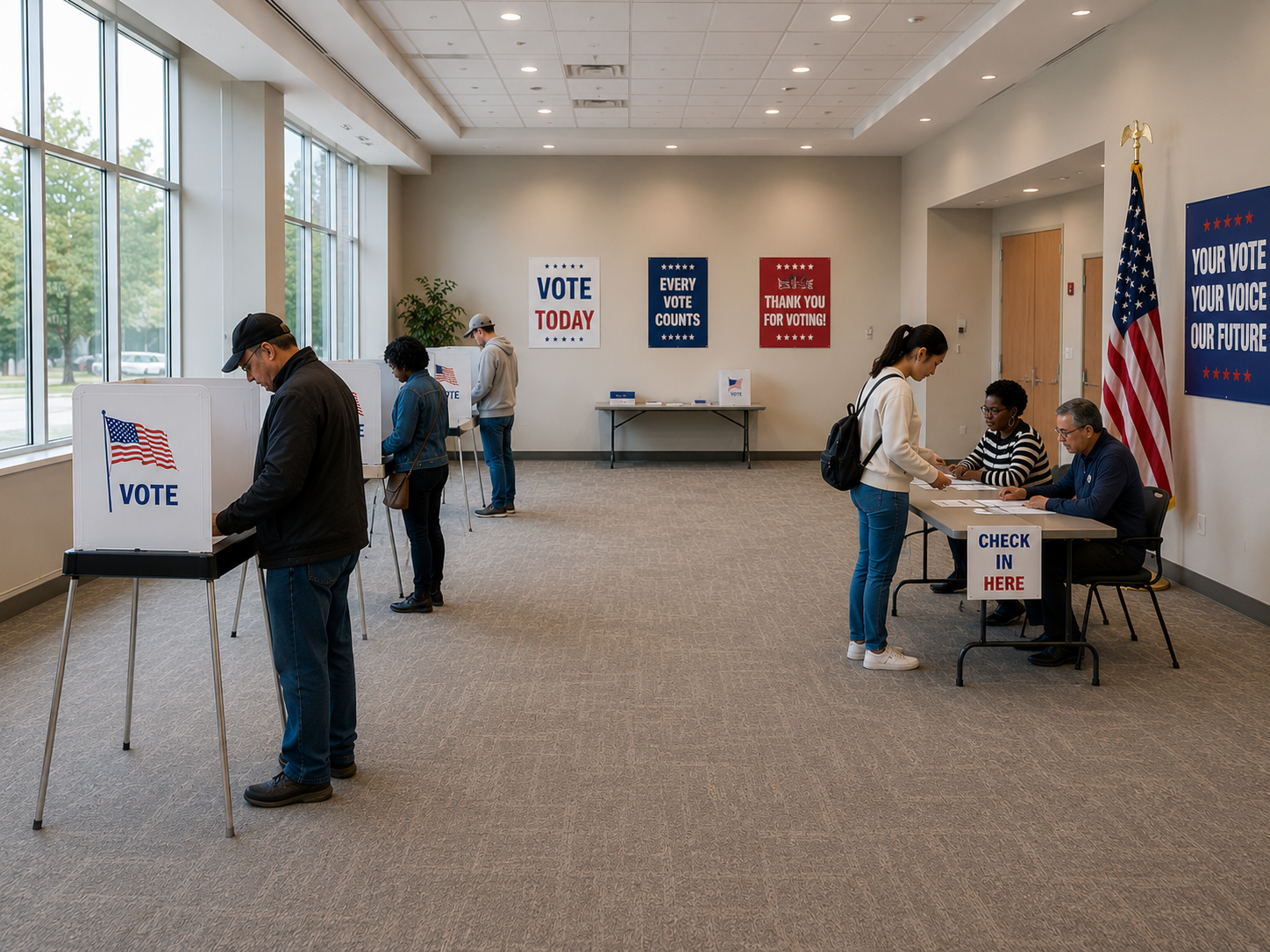
Voting access
Automatic and same-day registration. Multi-day, multi-mode voting. End purges that disenfranchise eligible voters in the name of list maintenance.
Fair maps
Independent commissions, not legislators, draw districts. Federal standards on partisan and racial gerrymandering with a real enforcement mechanism.
Money in politics
Donor disclosure for all federal political spending, including 501(c)(4) dark money. End super PAC coordination. Public matching funds for small donors.
Election administration
Federal standards for ballot security, post-election audits, and election worker protections. Adequate funding so administrators can do the job.
Counter election subversion
Clear rules for certification, finality of vote totals, and consequences for officials who refuse to certify lawful results.
Facts on file
What's actually true
- Since the Supreme Court gutted Voting Rights Act preclearance in 2013, dozens of states have enacted voting restrictions that would previously have required federal review.
- More than 90% of US House districts are now considered uncompetitive in general elections — most general-election races are decided in primaries.
- Roughly half of all federal political spending now flows through entities that disclose little or nothing about their donors.
- Voter purges have removed millions of registrations in the past decade; some are reasonable list maintenance, others have disproportionately removed eligible voters.
- Roughly half of US states had attempted to ban or significantly restrict mail-in voting through ballot measures or legislation in the years following the 2020 election.
- Election officials have reported sharply increased threats and harassment since 2020, contributing to high turnover in administrative positions.
In context
Read the issue
Democracy is not a self-sustaining condition. It is a set of practices, rules, and institutions that erode without maintenance. The question is not whether the United States is currently democratic in some abstract sense — it is whether the basic mechanisms of consent (a vote that counts, a district that is fairly drawn, a campaign whose funders are known, an election that is administered and certified honestly) are functioning. On all of these, the trend has been the wrong direction since at least 2010. The trend is reversible.
The five sub-topics below — voting access, fair maps, money in politics, election administration, and counter election subversion — are the load-bearing fights. The first determines who gets to participate. The second determines whether their participation translates into representation. The third determines whose voices get amplified above the rest. The fourth determines whether the operational infrastructure of elections is funded and protected. The fifth determines whether the results, once counted, are honored.
What unites them is a recognition that democratic institutions are conventions, not laws of nature. They are sustained by the willingness of the people inside them to follow rules that don’t, in the moment, advantage them. When that willingness erodes — through cynicism, through partisan capture, through the accumulation of small departures from norms — the institutions erode with it. The work of democratic reform is the work of rebuilding those rules and norms, slowly, in the open, against opposition that benefits from their absence.
Sub-topics
The conversation, broken down
Voting access
The mechanics that determine whether an eligible voter can vote.
Voting access is the most measurable of the democracy questions. The empirical record is clear: voter ID requirements, registration deadlines, polling place closures, voter purges, restrictions on mail and early voting, and limitations on assistance for voters with disabilities all reduce turnout in measurable ways, and the reductions concentrate among voters who are younger, lower-income, less white, or otherwise more difficult to mobilize. The reform agenda is specific. Automatic voter registration, where eligible citizens are registered when they interact with state agencies (DMV, public benefits, etc.) unless they opt out. Same-day registration, allowing eligible voters to register at the polling place on Election Day. Multi-day, multi-mode voting that doesn't force everyone into a single Tuesday. Restoration of the Voting Rights Act preclearance regime, which until 2013 required jurisdictions with a history of discrimination to clear changes in voting law with the Justice Department. The John R. Lewis Voting Rights Advancement Act would do this. None of it is novel. Most of it is the standard practice of other advanced democracies.
Fair maps
Why independent redistricting is a structural reform, not a partisan one.
Most US House districts are not competitive — most general-election races are decided in primaries, and most primaries are decided by a small slice of partisans. The cause is twofold: residential sorting (Democrats clustering in cities, Republicans in exurbs and rural areas) and active gerrymandering. Active gerrymandering is the part that's reversible by policy. Independent redistricting commissions, where a body insulated from the legislative majority draws district maps under transparent criteria, have been adopted in some form in California, Michigan, Arizona, Colorado, and others. The empirical record is that they produce more competitive districts, more communities of interest kept whole, and higher public confidence in the process — independent of which party benefits in any given cycle. The federal lever is the Freedom to Vote Act and similar legislation, which would set federal standards for redistricting (including bans on partisan and racial gerrymandering) with judicial enforcement. The 2019 Supreme Court ruling in Rucho v. Common Cause held that federal courts could not adjudicate partisan gerrymandering claims under the Constitution, which is why federal legislation is now the operative path.
Money in politics
What changed after Citizens United and what reform options remain.
The 2010 Supreme Court ruling in Citizens United v. FEC held that corporate political spending is protected speech and cannot be capped. The subsequent decision in SpeechNow v. FEC enabled super PACs that can raise unlimited sums from any source, on the theory that independent expenditures don't corrupt because they're not coordinated. The combined effect has been to move vast political spending out of formal campaign committees and into super PACs and 501(c)(4) 'social welfare' organizations that don't disclose donors. Roughly half of federal political spending in recent cycles flowed through entities that disclose little or nothing about their funders. Reform options within the constitutional framework are real but bounded. Donor disclosure laws (the DISCLOSE Act and state analogues) survive constitutional scrutiny in ways that contribution caps don't. Meaningful enforcement of the no-coordination rule between super PACs and campaigns. Public matching funds for small donors (the federal version is decades old; the New York City model and the FENA proposals would multiply small donations 6:1 with public funds). A constitutional amendment overturning Citizens United would be the most direct fix; it has been proposed but has not advanced. The reform politics of money in politics are difficult precisely because the people with the most resources to defend the current rules are the same ones who benefit from them.
Election administration
The unglamorous work that determines whether elections actually run.
Election administration in the US is decentralized to roughly 8,000 jurisdictions: counties, towns, cities, parishes. Most administrators are nonpartisan civil servants doing technical work — registration databases, ballot printing, polling-place logistics, post-election audits, equipment certification. Adequate funding has chronically been a problem; election infrastructure spending is bursty (around presidential cycles) when it should be steady. The post-2020 environment has compounded the problem. Election workers face increased threats and harassment, with measurable impact on retention; experienced administrators have left in significant numbers. Reform priorities: predictable federal funding (around $400M-$1B annually depending on cycle phase), legal protections for election workers against threats and intimidation, federal standards for post-election audits (most states now have some form of risk-limiting audit, but coverage is uneven), and equipment standards that don't lock administrators into a small number of vendors. None of this is partisan in the contested sense. It's the basic operational infrastructure of elections.
Counter election subversion
What rules need tightening when officials refuse to certify lawful results.
The 2020 election cycle stress-tested several assumptions about how American elections work, including the assumption that certification of vote totals by state and local officials is a clerical function that doesn't admit of meaningful discretion. The 2022 Electoral Count Reform Act addressed the federal piece — clarifying the Vice President's purely ceremonial role, raising the threshold for congressional objections to electoral votes, and tightening the timeline for state-level disputes. State-level reforms remain uneven. Several states have clarified that certification is mandatory and ministerial; others have not. Several states have imposed criminal penalties on officials who refuse to certify lawful results; others rely on civil remedies. Several states have created emergency-certification mechanisms when officials decline; others rely on writs of mandamus. The substantive principle is that the finality of vote totals is a foundational premise of representative government — when officials refuse to certify, the system has to have answers ready, and the answers cannot themselves be partisan.
Legislation
Key bills to watch
| Bill | What it does | Status |
|---|---|---|
| Freedom to Vote Act federal | Federal standards for voting access (automatic registration, same-day registration, early voting), bans on partisan gerrymandering, and donor disclosure. | Passed House in prior sessions; stalled in Senate |
| John R. Lewis Voting Rights Advancement Act federal | Restores VRA preclearance regime; updates the coverage formula struck down in Shelby County v. Holder (2013). | Passed House in prior sessions; stalled in Senate |
| Electoral Count Reform Act federal | Clarifies VP role in electoral certification; raises threshold for congressional objections; tightens state-level dispute timelines. | Enacted Dec 2022 |
| DISCLOSE Act federal | Requires donor disclosure for major political spenders, including 501(c)(4)s and super PACs. | Reintroduced March 2026 with updated text; not advanced |
| Fair Elections Now Act / FENA federal | Public matching funds (6:1) for small-dollar donations to congressional candidates. | Reintroduced; not advanced |
| State independent redistricting amendments state | Constitutional amendments establishing independent commissions; passed in CA, MI, AZ, CO, others; ongoing campaigns elsewhere. | Posture now defensive; Utah repeal initiative pending, CA Prop 50 mid-decade map upheld |
| Election worker protection bills state | Criminal and civil penalties for threats against election officials; protections against doxxing. | Enacted in several states; pending in many more |
Who's affected
Who carries the cost, who reaps the benefit
Voting restrictions and unaccountable money do not affect everyone equally. The empirical record on voter ID, registration restrictions, polling place closures, and mail-voting limitations is consistent: turnout falls most among voters who are younger, lower-income, more mobile, less white, and less attached to a single residential address. Voters with disabilities face particular barriers from polling-place inaccessibility and restrictions on third-party assistance.
Geographically, the gerrymandering problem concentrates in states without independent redistricting. Voters in non-competitive districts have effectively less influence on general elections than voters in competitive ones. The 90%+ uncompetitive-district figure means most Americans live in districts where the general-election outcome is foregone, leaving primaries — typically dominated by small partisan electorates — as the only meaningful contest.
The benefits of dark money and unaccountable spending flow to the donors who can afford to buy access without disclosure, and to the candidates and causes those donors choose to support. The asymmetry is structural: small donors can give visibly, mid-size donors can give visibly and risk reputational consequences, and the largest donors can give invisibly through dark-money channels with no public accountability. The political market this creates does not produce the policies most voters say they want.
Election workers — overwhelmingly nonpartisan civil servants — bear an increasing share of the operational cost of contested elections. The threat environment, retention crisis, and inadequate federal funding all concentrate in the smaller and rural jurisdictions least equipped to absorb additional load.
Timeline
How we got here
- Voting Rights Act passes, including preclearance regime (Section 5).
- 26th Amendment lowers voting age to 18.
- National Voter Registration Act ('Motor Voter') requires DMV-based registration.
- Help America Vote Act enacted post-2000; provides federal funding for election infrastructure modernization.
- Citizens United v. FEC ruling enables unlimited corporate political spending. SpeechNow v. FEC follow-on enables super PACs.
- Shelby County v. Holder strikes down the VRA preclearance coverage formula.
- Husted v. Randolph Institute upholds Ohio's voter purge process for non-voting.
- Rucho v. Common Cause rules that partisan gerrymandering claims are non-justiciable in federal court.
- Wave of state voting laws enacted post-2020, including restrictions on mail and drop-box voting.
- Electoral Count Reform Act enacted, addressing post-election certification and congressional objection rules.
- Multiple state legislatures pass election-worker protection laws and certification mandates.
- Several state independent redistricting commission ballot measures advance.
- John R. Lewis VRA Advancement Act and Freedom to Vote Act reintroduced; active state-level fights over mail voting and certification.
- Supreme Court rejects a challenge to California's Prop 50 mid-decade map (Feb), having earlier stayed a block on Texas's new map (Dec 2025).
- Louisiana v. Callais narrows VRA Section 2; the Court then vacates the Allen v. Milligan injunction and remands the Mississippi and North Dakota redistricting cases (Apr-May).
- Tennessee and Florida enact new maps dismantling majority-Black districts.
Glossary
Plain-language definitions
- Preclearance
- The Voting Rights Act regime (Section 5) requiring jurisdictions with a history of discrimination to obtain federal approval for any change in voting law before implementing it. Effectively neutralized by Shelby County v. Holder (2013); the John Lewis Act would restore it with an updated coverage formula.
- Section 2 (VRA)
- The Voting Rights Act provision still in force, prohibiting voting practices that discriminate on the basis of race. Requires litigation after the fact (unlike preclearance, which prevented changes from taking effect).
- Gerrymandering
- Drawing legislative district lines to advantage one party or group. Partisan gerrymandering favors a political party; racial gerrymandering favors or disadvantages a racial group. Both are common; partisan gerrymandering is unenforceable in federal court after Rucho v. Common Cause (2019).
- Citizens United
- 2010 Supreme Court ruling that corporate political spending is protected speech and cannot be capped. Combined with the subsequent SpeechNow ruling, enabled super PACs and the modern dark-money infrastructure.
- Super PAC
- Political action committee that can raise and spend unlimited sums from any source (corporations, unions, individuals) on independent expenditures advocating for or against candidates. Cannot legally coordinate with candidate campaigns; coordination rules are weakly enforced.
- Dark money
- Political spending by entities (typically 501(c)(4) social welfare organizations) that are not required to disclose their donors. Roughly half of federal political spending now flows through dark-money channels in recent cycles.
- Independent redistricting commission
- A body insulated from the legislative majority that draws district maps under transparent criteria. Adopted in California, Michigan, Arizona, Colorado, and several other states; produces more competitive districts and higher public confidence.
- Risk-limiting audit
- A statistically rigorous post-election audit that confirms (or fails to confirm) the reported winner with a target confidence level. Now adopted in some form in most US states; the gold standard of election integrity.
- Voter purges
- Removal of names from voter registration rolls. Some are reasonable list maintenance (deceased voters, confirmed moves); some have disproportionately removed eligible voters. The 2018 Husted v. Randolph Institute ruling allows states to remove voters for non-voting under specified procedures.
Research
Briefs on this issue
Brief
Voting rights, December 2025 to May 2026
Texas's mid-decade map. The Section 2 narrowing in Callais. Virginia's redistricting amendment voided. Five months of voting-rights doctrine remade.
Brief
Independent redistricting commissions, ten years in
What the empirical record shows about commissions in California, Michigan, Arizona, and Colorado — and where the next adoption fights are.
Brief
Dark money disclosure — what's possible after Citizens United
The constitutional space, the federal proposals, and what state-level disclosure laws have actually achieved.
Brief
Rucho v. Common Cause and the state-court gerrymandering path
After the 2019 ruling closed federal courts to partisan gerrymandering claims, state courts and ballot measures became the operative venues.
Engage
What you can do
Letters
- To a state legislator: support an independent redistricting commission A constituent letter urging a state representative to support the establishment of an independent redistricting commission ahead of the next census cycle.
- To a US Senator: support the Freedom to Vote Act and DISCLOSE Act Federal voting access protections and dark-money disclosure. Both have been introduced repeatedly; Senate procedural posture is the binding constraint.
Actions
- Push for an independent redistricting commission in your state Active campaigns in Ohio, Wisconsin, Pennsylvania, Florida, and others. The 2030 census is the deadline. Find a letter template →
- Support the DISCLOSE Act The most achievable structural reform on money in politics. Disclosure survives Citizens United; the political opposition is donor-driven, not constitutional. Find a letter template →
- Support state-court litigation and ballot measures on redistricting After Rucho closed federal courts to partisan-gerrymandering claims, state-level work has produced real wins. The next round needs sustained engagement. Find a letter template →