Issue area
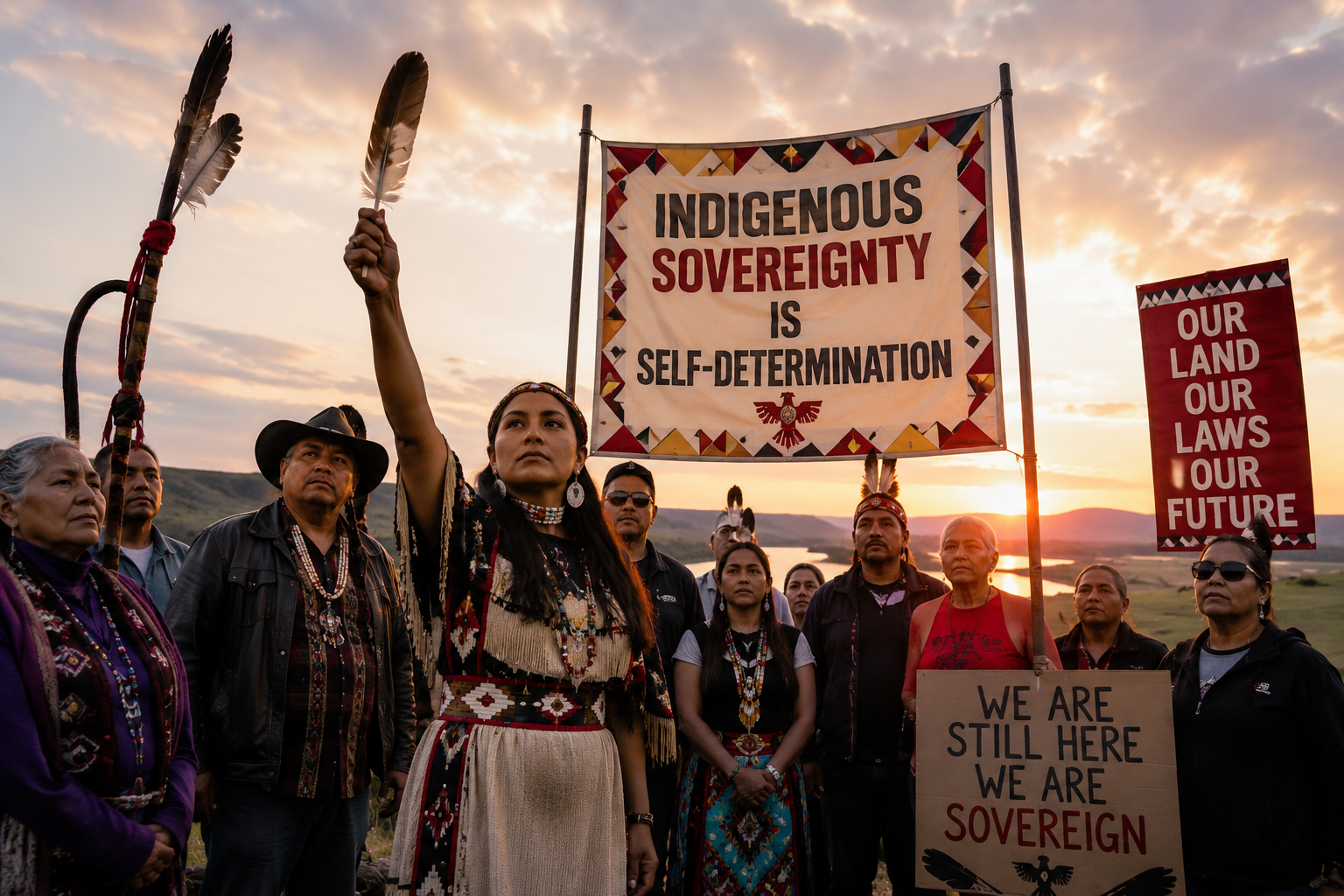
Treaties are the supreme law of the land. Honor them.
We support full implementation of tribal self-determination, mandatory IHS funding parity with comparable federal health programs, defense of the Indian Child Welfare Act and other foundational federal Indian law, and meaningful consultation on federal actions affecting tribal lands and resources.
Pillars
Where we plant our flag
Treaty obligations
Treaties between the United States and tribal nations are, under Article VI, the supreme law of the land. The federal government's compliance has been incomplete since the treaties were signed.
Tribal self-determination
The Indian Self-Determination and Education Assistance Act framework should be the default. Tribes contracting and compacting their own programs, with adequate federal funding, consistently produces better outcomes.
IHS funding parity
Indian Health Service funding has been chronically below comparable federal health programs. Mandatory funding (rather than discretionary) and substantial appropriations increases would address the pattern.
Defend ICWA and federal Indian law
The Indian Child Welfare Act survived a major constitutional challenge in 2023 (Haaland v. Brackeen). The broader edifice of federal Indian law remains under sustained legal pressure.
Consultation that means something
Federal consultation requirements with tribal governments are extensive on paper. Implementation has been uneven. Meaningful consultation includes timing, scope, and authority to affect outcomes.
Facts on file
What's actually true
- There are 574 federally recognized tribal nations in the United States.
- The Indian Health Service per-capita funding has historically been less than half of comparable federal health programs (Medicare, VA, Medicaid).
- Native Americans face among the worst chronic-disease outcomes in the developed world, intersecting the IHS funding gap directly.
- ICWA was upheld 7-2 by the Supreme Court in 2023's Haaland v. Brackeen, but elements of its constitutional foundation remain subject to ongoing legal pressure.
- Roughly 56 million acres are held in trust by the federal government for tribes and individual Indians; trust management has produced multi-billion-dollar settlements over historical mismanagement.
- The Missing and Murdered Indigenous Women crisis has produced federal action (Savanna's Act, Not Invisible Act) but data infrastructure and case investigation remain inadequate.
- The McGirt v. Oklahoma ruling (2020) reaffirmed that much of eastern Oklahoma remains Indian Country for jurisdictional purposes, with substantial subsequent litigation.
In context
Read the issue
The federal-tribal relationship is one of the most distinctive elements of the American constitutional order — and one of the most consistently failed in the United States’ performance of its commitments. Treaty obligations dating to the 19th century remain partly unfulfilled. IHS funding has been chronically below comparable federal health programs for the agency’s entire existence. ICWA, the Indian Self-Determination Act, and other foundational federal Indian law sit on legal foundations that the federal courts have begun to test in ways that would have been unthinkable a generation ago.
The five sub-topics below — treaty obligations, self-determination, IHS funding, ICWA and federal Indian law, and consultation/MMIW — are the load-bearing fights. They are interrelated. IHS funding is shaped by congressional politics; congressional politics is shaped by whether tribal interests are organized and represented. ICWA’s constitutional foundations were tested in the courts; the political response shapes the next round of testing. The MMIW crisis is the most visible symptom of jurisdictional fragmentation that runs through other domains as well.
What we try to bring to this issue is what we try to bring to every issue: facts on the record, plain-language explanation of what’s at stake, and tools for constituents to weigh in with their representatives. The work is unromantic, mostly bipartisan in its successful moments, and important in proportion to the constitutional commitments involved. Treaty obligations are not optional. Trust responsibility is not a discretionary line item. Honoring those commitments is the work of any government that wishes to be governed by its own founding principles.
Sub-topics
The conversation, broken down
Treaty obligations
What 'the supreme law of the land' has meant in practice.
Article VI of the Constitution makes treaties — including treaties between the United States and tribal nations — part of the supreme law of the land. The federal government has signed hundreds of treaties with tribal nations, most in the 19th century, establishing reservation boundaries, hunting and fishing rights, water rights, and trust obligations. Compliance has been incomplete since the treaties were signed. Treaty-rights litigation in federal courts, particularly through the Pacific Northwest fishing-rights cases of the 1970s (Boldt decision), has produced incremental enforcement, but the federal-government honoring of its treaty obligations has rarely been treated as a binding policy constraint at the political level. Reform options: meaningful federal staffing of the Office of Special Trustee for American Indians and Bureau of Indian Affairs; statutory codification of consultation rights that cross-reference treaty obligations; structural reforms within the executive branch to ensure treaty obligations are evaluated alongside other federal commitments rather than after them; and continued robust support for tribes' use of federal courts to enforce treaty rights.
Tribal self-determination
What changed in 1975, why it works, and where it's stuck.
The Indian Self-Determination and Education Assistance Act of 1975 (ISDEAA) created the framework for tribes to contract and compact for the federal services BIA and IHS would otherwise provide directly. Under contracting (Title I) and compacting (Title V) authorities, tribes operate their own healthcare systems, education programs, social services, and other federal-funded activities — with funding that follows the population they serve. The empirical record on self-determination is strong: tribes operating their own programs consistently produce better outcomes than direct federal service delivery, with tighter community fit, higher accountability, and more efficient administration. The constraint is funding. Tribally operated programs receive the same per-capita appropriation as federally operated ones, which means underfunding at the federal level cascades to underfunding at the tribal level. Reform priorities: substantial increases in IHS and BIA appropriations (which then flow to tribally operated programs proportionally); contract support cost reform (the indirect costs of running tribal programs are chronically underfunded relative to actual cost); expanded tribal authority to access additional federal funding streams (the 2023 PROGRESS Act and similar proposals address this incrementally).
IHS funding
Why Native Americans face among the worst US chronic-disease outcomes despite a federal trust health system.
The Indian Health Service is the federal agency responsible for healthcare for federally recognized American Indian and Alaska Native tribal members. Its mandate stems from treaty obligations and federal law dating to the 19th century. Its funding has been chronically inadequate. Per-capita IHS spending has historically been less than half of per-capita Medicare or VA spending — and the ratio shifts depending on counting methodology, but is consistently far below comparable federal health programs. The funding gap has measurable health consequences: Native Americans face among the worst chronic-disease outcomes in the developed world, with diabetes, cardiovascular disease, and substance-use disorders at rates that the IHS system is structurally underfunded to address. Reform options: making IHS funding mandatory rather than discretionary (proposals to do so have advanced periodically; the 2018 advance appropriation provision was a partial step); appropriations increases targeted to bring per-capita funding closer to parity with comparable programs; expanded Medicaid third-party billing in Indian Country (which provides additional revenue without offsetting IHS appropriations); and structural integration of IHS with the broader federal healthcare landscape so that uncompensated care doesn't fall entirely on tribal facilities.
ICWA and federal Indian law
What survived in Haaland v. Brackeen, and what the next legal fights look like.
The Indian Child Welfare Act of 1978 was enacted in response to the systematic removal of Native children from their families and tribes — a pattern that had been federal policy in various forms for over a century. ICWA establishes substantive and procedural protections for Native children in state child custody proceedings, including placement preferences favoring extended family and tribal members. The 2023 Supreme Court ruling in Haaland v. Brackeen rejected a constitutional challenge that would have invalidated ICWA, with the Court ruling 7-2 in favor of the law's continued application. The ruling preserved ICWA but did not foreclose all future challenges; subsequent litigation continues to test specific provisions and applications. Beyond ICWA, federal Indian law has been under sustained legal pressure — challenges to the Indian Commerce Clause's scope, to the political (rather than racial) classification of tribal members, and to specific tribal-government authorities have advanced in federal courts. Defense of the legal architecture requires continued robust federal support for tribal sovereignty, careful litigation strategy, and statutory reinforcement where Court rulings open gaps.
Consultation and the MMIW crisis
Two intersecting concerns: how federal decisions get made and the violence Native women face.
Federal consultation requirements with tribal governments — under Executive Order 13175 and various statutes — are extensive on paper. Implementation has been uneven. Federal agencies often consult late in decision-making processes, with limited authority to affect outcomes; consultation can become a procedural box-check rather than meaningful engagement. Reform options: statutory codification of the executive-order requirements, with clear standards for timing, scope, and authority; expanded tribal liaison capacity within federal agencies; and meaningful enforcement mechanisms when consultation requirements are not met. Separately but relatedly, the Missing and Murdered Indigenous Women (MMIW) crisis is among the most documented gaps in US criminal-justice infrastructure. Native women face homicide rates dramatically higher than the national average, with case-investigation, data, and jurisdictional fragmentation compounding the harm. Federal action — Savanna's Act and the Not Invisible Act, both enacted in 2020 — created reporting requirements and coordination structures. Implementation remains in progress; data infrastructure is improving but inadequate; case investigation across federal, state, tribal, and (in some cases) bordering-country jurisdictions remains structurally fragmented.
Legislation
Key bills to watch
| Bill | What it does | Status |
|---|---|---|
| PROGRESS Act federal | Expands tribal access to federal funding programs; clarifies sovereignty in specific federal-program contexts. | Periodic enactments and reauthorizations |
| IHS Mandatory Funding Act federal | Makes Indian Health Service funding mandatory rather than discretionary; addresses the chronic appropriations-cycle vulnerability. | Reintroduced multiple sessions; partial advance appropriations enacted |
| Truth and Healing Commission on Indian Boarding School Policies Act federal | Establishes federal commission to investigate the boarding school era; provides for comprehensive historical record and survivor support. | S.761 cleared Senate Indian Affairs Committee, on Senate calendar; House companion H.R.7325 introduced Feb 2026 |
| Native American Voting Rights Act federal | Targeted protections for Native American voting access, including ID requirements, mail voting, and polling place access on reservations. | In committee |
| Savanna's Act / Not Invisible Act federal | Federal reporting and coordination on Missing and Murdered Indigenous Women cases; data infrastructure development. | Enacted 2020; implementation ongoing |
| Indian Child Welfare Act federal | 1978 statute; survived constitutional challenge in Haaland v. Brackeen (2023); subsequent litigation continues. | In force; subject to ongoing legal testing |
| Tribal-state water-rights settlements federal | Multi-tribe water-rights settlements addressing historical claims; require federal funding and statutory ratification. | Periodic enactments; multiple settlements pending |
Who's affected
Who carries the cost, who reaps the benefit
Federal Indian policy affects roughly 9.7 million Americans who self-identify as American Indian or Alaska Native (alone or in combination), and the 574 federally recognized tribal nations of which they are members.
IHS underfunding falls heaviest on tribal members in the most rural and lowest-resource communities — particularly in the Great Plains, the Southwest, and Alaska. Chronic disease outcomes (diabetes, cardiovascular disease, substance use) are concentrated in populations the IHS system is structurally underfunded to serve.
ICWA protections affect Native children involved in state child welfare systems — disproportionately overrepresented in those systems for historical and structural reasons. The legal architecture of federal Indian law affects all 574 tribal nations and their members, with each major Supreme Court ruling shifting the landscape.
The MMIW crisis falls on Native women specifically, with documented disparities in homicide rates, sexual assault rates, and case-investigation outcomes. Native women living on reservations face particular jurisdictional fragmentation; Native women living off-reservation face the broader documented patterns plus reduced access to tribal-court remedies.
Treaty-rights enforcement affects fishing, hunting, water-using, and resource-using communities of treaty-rights-holding tribes. The Pacific Northwest, Great Lakes, Southwest, and Alaska have particularly active treaty-rights litigation environments.
The benefits of inadequate federal Indian policy infrastructure flow to extractive industries on or adjacent to tribal lands, to states resistant to tribal sovereignty (in PL 280 jurisdictions and elsewhere), and to the political ecosystem that benefits from a tribally fragmented and structurally underfunded constituency.
More broadly, the failure to honor treaty obligations is a failure of constitutional commitment that affects the broader rule of law. Article VI's promise that treaties are part of the supreme law of the land is undermined when the political branches treat tribal treaty obligations as discretionary while treating other Article VI commitments as binding.
Timeline
How we got here
- Indian Removal Act passes; subsequent Trail of Tears and forced removals.
- Worcester v. Georgia establishes core principle of tribal sovereignty under federal supervision.
- Indian Appropriations Act ends new treaty-making with tribes (existing treaties remain in force).
- Dawes Act allots tribal lands to individuals; substantial loss of tribal land base follows.
- Indian Citizenship Act extends US citizenship to all American Indians.
- Indian Reorganization Act ends allotment, supports tribal self-government.
- Termination policy begins; Public Law 280 transfers federal jurisdiction over crimes in Indian Country to certain states.
- Indian Civil Rights Act extends most Bill of Rights protections to tribal courts.
- United States v. Washington (Boldt decision) reaffirms tribal treaty fishing rights in the Pacific Northwest.
- Indian Self-Determination and Education Assistance Act passes.
- Indian Child Welfare Act, American Indian Religious Freedom Act, Tribally Controlled Community College Assistance Act.
- Indian Gaming Regulatory Act creates federal framework for tribal gaming.
- Tribal Law and Order Act expands tribal-court authority.
- Violence Against Women Act reauthorization includes tribal jurisdiction over non-Indian domestic violence offenders.
- McGirt v. Oklahoma reaffirms much of eastern Oklahoma as Indian Country; Savanna's Act and Not Invisible Act enacted.
- Bipartisan Infrastructure Law and Inflation Reduction Act include substantial tribal-specific provisions.
- Haaland v. Brackeen upholds ICWA against constitutional challenge.
- Continued tribal infrastructure spending implementation; ongoing federal Indian law litigation; MMIW data infrastructure development.
- Minnesota Supreme Court rejects a constitutional challenge to ICWA; Supreme Court denies cert in Stroble v. Oklahoma Tax Commission, allowing state income tax on tribal citizens living on-reservation.
- Supreme Court vacates Turtle Mountain Band v. Howe and remands for reconsideration in light of Louisiana v. Callais.
Glossary
Plain-language definitions
- Federally recognized tribe
- Tribal nation recognized by the federal government as having a government-to-government relationship with the United States. There are 574 federally recognized tribes; recognition status carries substantial legal consequences.
- Trust responsibility
- The federal government's legal obligations to tribes and their members, derived from treaties, federal statutes, and Supreme Court rulings. Includes obligations regarding land, resources, healthcare, education, and other domains.
- ISDEAA / Self-Determination
- The Indian Self-Determination and Education Assistance Act of 1975, allowing tribes to contract and compact for federal services they would otherwise receive directly from BIA or IHS.
- ICWA
- Indian Child Welfare Act of 1978. Establishes substantive and procedural protections for Native children in state child custody proceedings, including placement preferences favoring extended family and tribal members.
- 638 contract
- Common shorthand for an ISDEAA Title I contract (named for the public law number 93-638). Allows tribes to operate federal programs.
- Compacting / Title V
- ISDEAA Title V framework allowing more comprehensive tribal operation of federal programs, with greater flexibility than 638 contracts.
- Indian Country
- Federal legal term defined at 18 U.S.C. § 1151 covering reservations, dependent Indian communities, and Indian allotments. Has substantial implications for jurisdiction over crimes.
- PL 280
- Public Law 83-280 (1953), transferring federal jurisdiction over crimes in Indian Country to certain states without tribal consent. A controversial mid-20th-century policy with continuing effects.
- MMIW / MMIWG / MMIP
- Missing and Murdered Indigenous Women / Girls / People. The documented crisis of disproportionate violence against Native women, addressed federally through Savanna's Act and the Not Invisible Act.
- Treaty rights
- Rights reserved to tribes in treaties with the United States, including hunting, fishing, water, land, and other resource rights. Subject to federal-court enforcement under Article VI.
Research
Briefs on this issue
Brief
Native voting rights after Callais: the Turtle Mountain remand
The Supreme Court vacated a ruling that would have barred Native voters from enforcing the Voting Rights Act themselves — and tied the case's fate to a decision that has nothing obvious to do with it.
Brief
Stroble and the narrowing of McGirt
Why the Supreme Court's refusal to hear an Oklahoma tax case matters: it leaves standing a state ruling that lets Oklahoma tax tribal citizens on their own reservations.
Brief
The boarding-school Truth and Healing Commission, finally moving
A bill to investigate the federal Indian boarding school system has stalled for five years. In the 119th Congress it has reached the Senate calendar and gained a bipartisan House companion — its furthest advance yet.
Brief
IHS funding parity — what's at stake
Why the Indian Health Service has been chronically underfunded relative to comparable federal health programs, and what mandatory funding would do.
Brief
ICWA after Haaland v. Brackeen
What the 2023 ruling preserved, what it left open, and where the next round of legal pressure on federal Indian law is heading.
Engage
What you can do
Letters
- To a US Senator: support mandatory funding for the Indian Health Service IHS funding has been chronically below comparable federal health programs for decades. Mandatory funding would address the structural cause.
- To a US Senator: support the Truth and Healing Commission on Indian Boarding Schools Federal commission to investigate the Indian boarding school era — the institutional pattern that produced multi-generational trauma still being reckoned with.
Actions
- Support mandatory funding for the Indian Health Service IHS funding has been chronically below comparable federal health programs for decades. Mandatory funding addresses the structural cause. Find a letter template →
- Support the Truth and Healing Commission on Indian Boarding Schools Federal commission to investigate the Indian boarding school era — the institutional pattern that produced multi-generational trauma still being reckoned with. Find a letter template →