Issue area
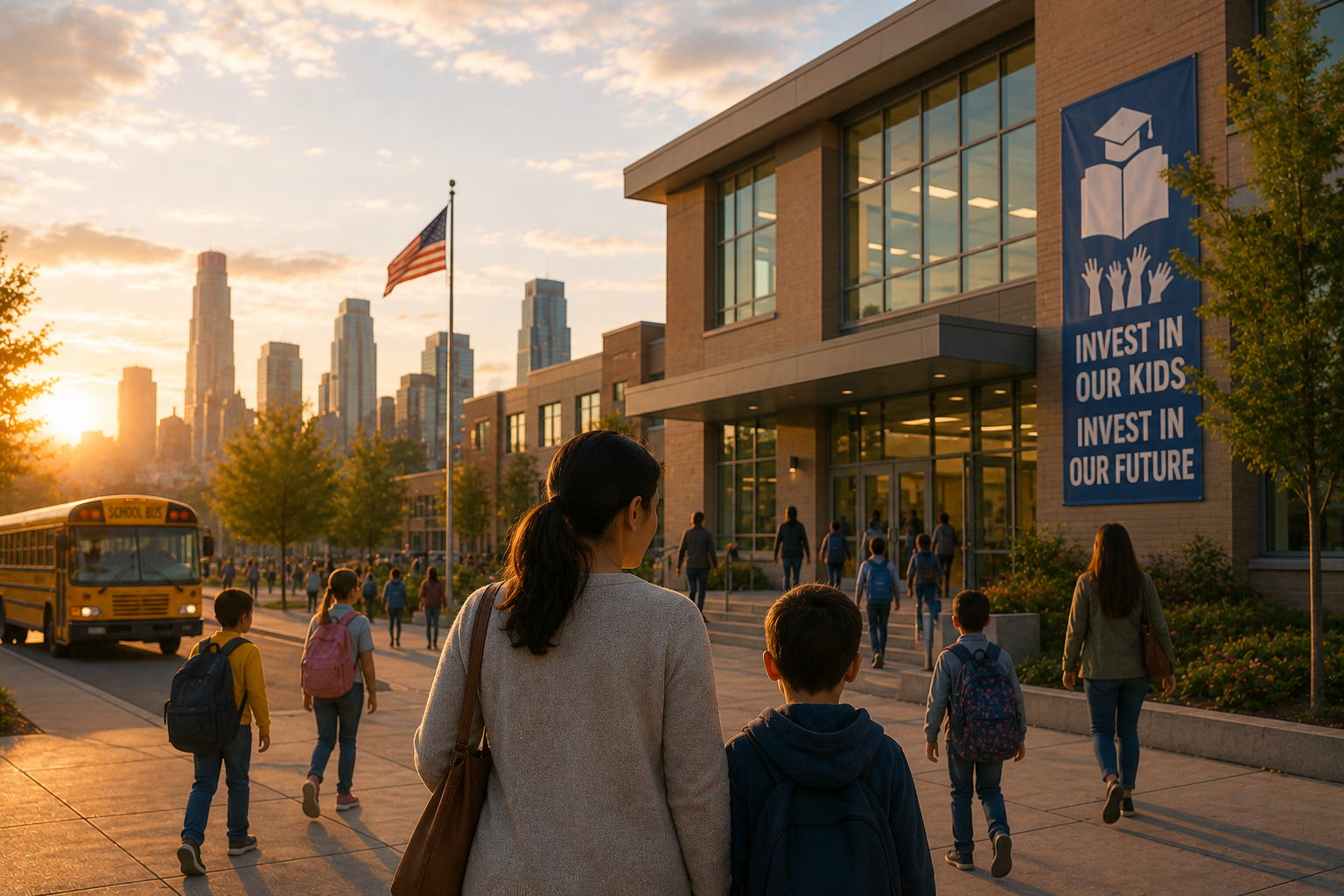
Public education is a public commitment. Treat it like one.
We support equitable funding for K-12 public schools, restoration of public-college affordability, structural relief from student debt, and resistance to voucher schemes that drain public resources for private benefit.
Pillars
Where we plant our flag
Fund public schools fairly
Adequate state funding formulas. Federal Title I expansion. Reverse the privatization-by-defunding pattern that has shrunk public school capacity in many states.
Restore public-college affordability
Tuition at four-year public universities was substantially free or low-cost in many states fifty years ago. The path back: state reinvestment, federal aid expansion, debt-free pathways for in-state residents.
Structural student debt relief
Income-driven repayment that actually works. Public Service Loan Forgiveness defended and expanded. Discharge for borrowers harmed by predatory for-profit schools.
Resist voucher schemes
School vouchers and ESAs (education savings accounts) drain public funds for unaccountable private use. The empirical record on outcomes is poor; the political dynamic is privatization, not choice.
Universal pre-K and child care
The most cost-effective public investment in education is early. Universal pre-K, expanded Head Start, and child care subsidies pay back many times over in long-term outcomes.
Facts on file
What's actually true
- US public-school funding remains one of the most unequal among advanced economies, with per-pupil spending varying by 2-3x across districts within the same state.
- Total US student loan debt now exceeds $1.7 trillion across 44 million borrowers.
- Voucher programs have expanded significantly in more than 15 states since 2020, with state spending in the billions diverted from public school systems; Texas launched a roughly $1 billion program in 2026.
- The Public Service Loan Forgiveness program discharged debt for over a million borrowers after 2021 reforms, but a 2026 rule allowing the Education Secretary to disqualify employers takes effect July 1, 2026 and is being challenged in court.
- Student-loan defaults surged in 2025-26 after the collections pause ended, with delinquency near 25% and roughly 3.6 million borrowers in default across two quarters.
- Research consistently shows public investment in early childhood education produces some of the highest long-term ROI of any public spending.
- Adjusted for inflation, state appropriations per public-college student in many states remain below 2008 levels.
In context
Read the issue
Education in America has been a public commitment since the Northwest Ordinance of 1787. The commitment has not been honored evenly. K-12 funding remains among the most unequal in the developed world. Public higher education, which provided substantially free college for a generation in many states, has been allowed to become unaffordable for the families who built it. Student debt now constrains the lives of 44 million Americans — disproportionately the same Americans who were told that taking it on was the responsible thing to do.
The five sub-topics below — K-12 funding equity, vouchers and ESAs, higher-ed affordability, student debt, and early childhood — are the load-bearing fights of education policy today. They are not the same fights, but they share a structural pattern: a public good built over generations, increasingly handed over to private extraction, with the costs concentrated on the families and communities that can least bear them. The path back is unromantic and slow: state-by-state funding work, federal program defense, voucher resistance, and the long arc of restoring debt-free public-college pathways for in-state residents.
What ties these to the broader project is a basic premise. Education is not an investment that pays back the investor; it is a commons that pays back the community. Treating it as a private investment with a private return — and pricing it accordingly — produces exactly the outcomes we are now living through.
Sub-topics
The conversation, broken down
K-12 funding equity
Why per-pupil spending varies so dramatically across US districts, and what would reduce the gap.
US K-12 funding draws from federal, state, and local sources, with the bulk traditionally from local property taxes. The result is one of the most unequal funding patterns among advanced economies — wealthy districts spend 2-3x what neighboring districts spend per pupil, often within the same state. State funding formulas were designed in part to mitigate this, but in many states the formulas are inadequate, outdated, or actively gamed by political dynamics. The federal lever (Title I) targets high-poverty schools but is far too small relative to the gap. Reform options span scales: state funding formula updates that account for actual cost-of-education differentials, federal Title I expansion (proposals to triple it have circulated for years), and litigation under state constitutional adequacy clauses, which has produced incremental but meaningful gains in several states.
Vouchers, ESAs, and the privatization pattern
School vouchers as a fiscal-political mechanism, not an education-policy one.
School voucher programs and education savings accounts (ESAs) have expanded rapidly since 2020, particularly in red states. Arizona, Florida, Iowa, Indiana, West Virginia, and others have enacted near-universal voucher programs that divert state education spending to private (often religious) schools. The empirical record on student outcomes is poor — most rigorous studies find vouchers produce neutral or negative outcomes for participating students compared to public-school peers. The political dynamic is the more important one: vouchers function as a fiscal mechanism for shrinking public school systems by reducing their funding base, while also subsidizing private school tuition for families that would have paid it anyway. Resistance focuses on state-level legislation, ballot measures (which have repeatedly defeated voucher expansions when put to voters directly), and litigation under state constitutional clauses requiring adequate public education funding.
Public higher-ed affordability
How public university became expensive, and the path back.
Through the 1960s and 1970s, four-year public universities in many states (California's master plan being the best-known) provided substantially free or near-free tuition to in-state residents. State appropriations per student have declined since then, with sharp reductions during the 2008-2010 recession that were never fully reversed. The funding shortfall has been covered by tuition increases, which have driven the enrollment decline among lower-income students and the explosion of student debt. Restoring affordability requires both state-level reinvestment (a multi-decade trend that several states have begun reversing) and federal action (Pell Grant expansion, debt-free pathways for in-state residents at participating institutions, federal-state matching programs). The College for All proposals address this most directly; more incremental versions (Pell Grant doubling, free community college) have advanced periodically without reaching enactment.
Student debt
What broad cancellation, IDR reform, and PSLF together would do.
Total US student loan debt now exceeds $1.7 trillion across 44 million borrowers — larger than the credit card debt and auto loan markets, smaller only than mortgages. The structural problem is that debt has accumulated faster than wages have grown for the workers expected to repay it, and the standard repayment options (10-year fixed) are unaffordable for many. Three reform tracks: (1) broad cancellation, attempted by executive action under the 2003 HEROES Act and largely struck down by the Supreme Court in 2023; subsequent narrower cancellation has continued through targeted programs (PSLF, borrower defense, total and permanent disability discharge). (2) Income-driven repayment reform, including the SAVE plan, which substantially reduced monthly payments and accelerated forgiveness but was struck down — ended by a December 2025 settlement and an 8th Circuit ruling in March 2026. (3) Public Service Loan Forgiveness, which after 2021 reforms had discharged over a million borrowers' debt, though a 2026 rule taking effect July 1, 2026 lets the Education Secretary disqualify employers and is now in litigation. Defending and expanding all three is the active agenda.
Universal pre-K and child care
Where public investment produces the highest long-term return.
The empirical case for public investment in early childhood education is among the strongest in social-policy research. Programs like the Perry Preschool Project, the Carolina Abecedarian Project, and well-implemented Head Start have shown long-run effects on educational attainment, employment, earnings, criminal justice involvement, and health. The question is no longer whether to invest, but how to scale. The Build Back Better framework included universal pre-K and substantial child-care funding; the components were broken apart in the Senate, with most not enacted. State-level universal pre-K programs (in DC, NYC, Oklahoma, Florida, Georgia, others) provide working models. Federal options include direct funding to states for universal pre-K expansion, child-care worker wage floors (the workforce is chronically underpaid, contributing to high turnover and quality issues), and tax credit reforms (Child Tax Credit expansion, Child and Dependent Care Tax Credit reform).
Legislation
Key bills to watch
| Bill | What it does | Status |
|---|---|---|
| College for All Act federal | Tuition-free public college for in-state students at four-year and community colleges; doubles Pell Grant; funds public-college infrastructure. | Reintroduced; not advanced |
| Public Service Loan Forgiveness reforms federal | Administrative overhauls (2021-2023) that fixed the program. Subsequent legislation would codify the fixes and expand eligibility. | 2026 rule lets the Education Secretary disqualify employers (eff. July 1, 2026); multi-state and union lawsuits pending |
| SAVE Plan / IDR reform federal | Income-driven repayment overhaul reducing payments to 5% of discretionary income above an expanded threshold; faster forgiveness. | Struck down; ended by Dec 2025 settlement and 8th Circuit ruling (Mar 2026) |
| PRO-Educator Act / federal teacher pay floor federal | Federal grants conditioned on minimum teacher salaries; loan forgiveness for teachers in high-need schools. | Multiple proposals in committee |
| Universal Pre-K and Child Care for All Act federal | Federal funding to states for universal pre-K; child-care subsidies capped at 7% of family income. | Reintroduced multiple sessions; not enacted |
| State voucher programs (multiple) state | Near-universal ESAs in AZ, FL, IA, IN, WV, others. Several state ballot measures have defeated voucher expansions. | Active in multiple states; ongoing fiscal impact |
| Children's Health Insurance Program / school-based services expansion federal | Various proposals to expand Medicaid school-based services billing, supporting school nurses, counselors, and special education. | Partial enactment in 2022 omnibus; further expansion pending |
Who's affected
Who carries the cost, who reaps the benefit
Education funding inequities and the student debt crisis fall heaviest on the populations whose long-term outcomes already depend most on educational opportunity. K-12 funding gaps concentrate in high-poverty districts, which serve disproportionately Black, Latino, and rural-white students. Voucher expansions drain funding from those same districts most severely. Higher-ed affordability collapse has hit first-generation college students hardest, with college enrollment among lower-income students declining sharply over the past decade.
Student debt affects 44 million borrowers, but the burden distribution is uneven. Black borrowers carry higher debt loads relative to income and pay it down more slowly because of the racial wealth gap and labor-market discrimination. Borrowers who attended for-profit colleges are dramatically overrepresented in default and delinquency. Borrowers in public-service jobs (teachers, nurses, social workers) have specific federal relief through PSLF — when the program functions.
Early childhood education access patterns track inequality at the front end: high-income families pay for private pre-K and full-day quality care; lower-income families patch together informal care, partial Head Start, and family support. Universal pre-K and child care worker wage floors would close most of this gap.
The benefits of underfunding public education and crushing student debt accumulate at the top of the income distribution: in private schools that benefit from public-school degradation; in private colleges whose pricing power increases as public alternatives erode; in financial services firms that profit from the loan servicing infrastructure; in the political ecosystem that benefits from a workforce too constrained to organize, protest, or participate in extended civic life.
Timeline
How we got here
- Elementary and Secondary Education Act passes, including Title I.
- Higher Education Act passes, creating federal student aid framework.
- Title IX passes, prohibiting sex discrimination in education.
- Education for All Handicapped Children Act (now IDEA) requires public schools to serve students with disabilities.
- State higher-ed appropriations begin steady decline relative to enrollment growth; tuition rises to compensate.
- No Child Left Behind enacted, expanding federal testing and accountability requirements.
- Public Service Loan Forgiveness program created in College Cost Reduction and Access Act.
- Recession-era state budget cuts to higher education; appropriations per student fall sharply.
- Every Student Succeeds Act replaces NCLB, scaling back federal accountability requirements.
- Biden administration begins systematic reform of PSLF processing; over a million borrowers eventually approved.
- Supreme Court (Biden v. Nebraska) strikes down broad student loan cancellation; narrower targeted relief continues.
- Wave of state ESA/voucher programs enacted in AZ, FL, IA, IN, WV, others. State ballot measures repeatedly defeat voucher expansions when put to voters.
- SAVE plan implementation paused by litigation; partial IDR reforms continue. State adequacy lawsuits in NY, PA, others advance.
- A December 2025 settlement ends the SAVE plan; the 8th Circuit eliminates it outright in March.
- Student-loan defaults surge after the collections pause ends; the New York Fed reports 2.6 million defaults in the first quarter.
- OBBBA student-loan provisions (the Repayment Assistance Plan, Pell restrictions, Workforce Pell) take effect July 1.
Glossary
Plain-language definitions
- Title I
- The largest federal K-12 program, providing supplemental funding to schools serving students from low-income families. Substantially smaller than the funding gap it's intended to address.
- Voucher
- Public funds redirected to pay private school tuition. Functionally similar to ESAs (education savings accounts) but typically more restricted in use.
- Education Savings Account (ESA)
- A flexible voucher-equivalent — public funds deposited in an account that families can use for private school tuition, tutoring, homeschooling expenses, and other education costs. Currently expanding rapidly in red states.
- PSLF (Public Service Loan Forgiveness)
- Federal program that discharges remaining federal student loan balances after 10 years of payments while working full-time for a qualifying public-service employer. After years of mismanagement, now functioning.
- Income-driven repayment (IDR)
- Federal student loan repayment plans that cap monthly payments at a percentage of discretionary income, with remaining balance forgiven after 20-25 years (10 years for PSLF). The SAVE plan is the most generous version.
- Pell Grant
- Federal grant for low-income undergraduates that doesn't have to be repaid. Maximum award has fallen substantially relative to college costs since the 1970s.
- Borrower defense
- Federal student loan discharge available to borrowers whose schools defrauded them or made misrepresentations. Used at scale for closed for-profit colleges.
- Adequacy litigation
- State-level lawsuits challenging school funding levels under state constitutional clauses requiring adequate public education. Has produced meaningful gains in several states.
- Charter school
- Publicly funded but independently operated school. Different from voucher schools (which are private). Charter quality varies; the political question is governance and accountability.
- Universal pre-K
- Public funding for pre-kindergarten available to all 3- and 4-year-olds regardless of family income. Implemented in some form in DC, NYC, Oklahoma, Florida, Georgia, and a growing list.
Research
Briefs on this issue
Brief
Public Service Loan Forgiveness — fixed, then contested
How a program that didn't work for a decade started working in 2021 — and why a 2026 rule has put it back in dispute.
Brief
The SAVE plan is gone — and the repayment menu shrank with it
How the most generous income-driven repayment plan was eliminated, what the OBBBA student-loan overhaul replaces it with, and why a smaller menu of options matters for borrowers.
Brief
The student-loan default wave of 2025-26
After a five-year pandemic pause, federal student-loan default is showing up on credit reports again — about 3.6 million borrowers in two quarters — and the Fed warns a second wave is coming.
Brief
School vouchers as a fiscal mechanism, not an education policy
Why voucher and ESA expansions look more like a state-budget pattern than a school-choice movement — and what the empirical record actually shows.
Engage
What you can do
Letters
- To a US Senator: codify the PSLF reforms in statute Public Service Loan Forgiveness finally works after the 2021-2023 administrative reforms. Codifying them in statute would protect the program from administrative reversal.
- To a state legislator: oppose voucher / ESA expansion Voucher expansions have been advancing in many state legislatures. Where put to voters directly, they have repeatedly lost. Legislative pressure is the active lever.
Actions
- Oppose voucher / ESA expansion in your state Voucher proposals are advancing in many state legislatures. Constituent opposition has repeatedly defeated expansions when put to voters; legislative pressure is the active lever. Find a letter template →
- Support PSLF codification and IDR protection PSLF works now. Codifying the 2021-2023 reforms in statute would protect the program from administrative reversal. Find a letter template →