Issue area
Equal protection is not optional. Due process is not a slogan.
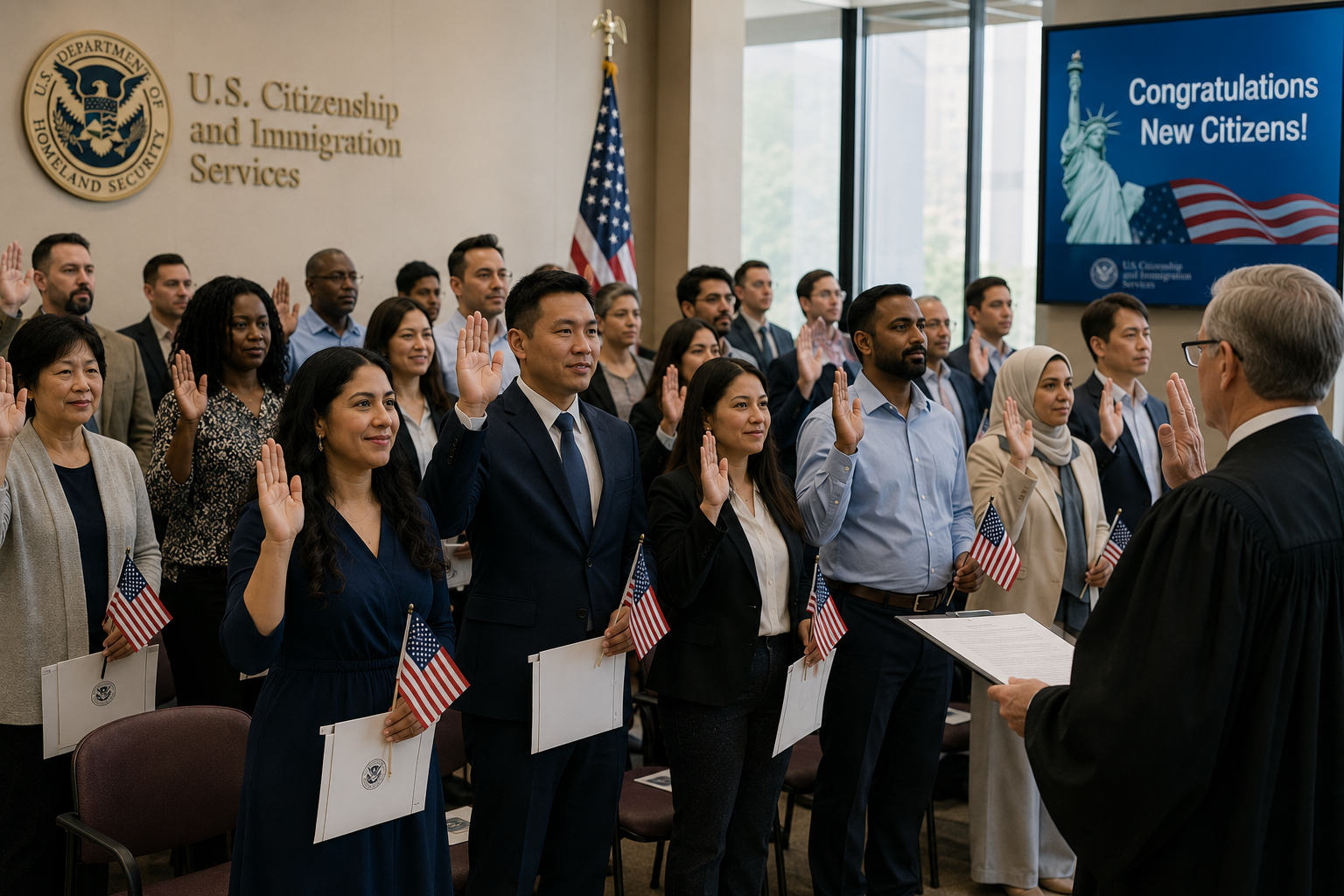
We support strong civil-rights enforcement, anti-discrimination protections, due process in immigration proceedings, and a path to citizenship for long-settled undocumented residents.
Pillars
Where we plant our flag
Civil rights enforcement
Restore and expand DOJ Civil Rights Division capacity. Pass the Equality Act. Protect voting, housing, and employment from discrimination on the basis of race, sex, gender identity, and disability.
Due process at the border
Asylum proceedings that meet international and constitutional standards. End indefinite family detention. Fund immigration courts so claims can actually be heard.
A workable system
Path to citizenship for DACA recipients, TPS holders, and long-settled undocumented residents. Visa reform that matches the workforce we actually have.
Police accountability
End qualified immunity for federal civil rights claims. Federal use-of-force standards. Pattern-and-practice investigations as a routine tool.
LGBTQ+ rights
Pass the Equality Act. Defend marriage equality. Protect transgender Americans from discrimination in housing, employment, and healthcare.
Facts on file
What's actually true
- The US immigration court backlog now exceeds 3 million cases; many people wait years for a hearing.
- Roughly 11 million undocumented residents live in the US — most for over a decade. The vast majority work and pay taxes.
- Civil-rights complaints to federal enforcement agencies routinely outnumber the staff available to investigate them by orders of magnitude — a gap widened sharply by the DOJ Civil Rights Division losing roughly 75% of its attorneys.
- Federal qualified immunity doctrine, created by Supreme Court precedent rather than statute, prevents most civil rights suits against police from reaching trial.
- DACA recipients have lived in the US an average of over 20 years; most arrived as small children.
- The Fair Housing Act of 1968 covers race, color, religion, sex, familial status, national origin, and disability; it does not federally cover sexual orientation or gender identity, though many states fill the gap.
- Roughly 30 states have laws criminalizing or restricting gender-affirming care for minors; the Supreme Court upheld such bans 6-3 in US v. Skrmetti (June 2025), and around 25 states' bans remain in effect.
In context
Read the issue
Civil rights and immigration policy are often discussed as separate domains. They share a deeper question: who gets the protection of American law, on what terms, and with what dignity? The current answer is uneven, contested, and increasingly subject to political mood. Our work names the constitutional and statutory commitments at stake, and the practical reforms that would honor them.
The five sub-topics below — civil rights enforcement, immigration courts, path to citizenship, police accountability, and LGBTQ+ rights — are the most concrete fights. They are not the same fights, but they share a structural pattern: rights that exist on paper depend on enforcement infrastructure to be real, enforcement infrastructure depends on funding and political will, and both can be eroded faster than they can be rebuilt. Maintenance of civil rights is therefore a continuous task, not an event.
What we try to bring to these fights is the same thing we try to bring to every fight: facts on the record, plain-language explanation of what’s at stake and what’s possible, and tools for constituents to weigh in with their representatives in language that sounds like them. The questions in this issue area are the most morally fraught of any we cover. We try to handle them with the seriousness and the restraint they deserve.
Sub-topics
The conversation, broken down
Civil rights enforcement
The federal civil rights infrastructure is severely understaffed for the workload.
Federal civil rights enforcement is divided across agencies — the Justice Department's Civil Rights Division, the EEOC, HUD's Office of Fair Housing, the Department of Education's Office for Civil Rights, the Department of Health and Human Services' OCR. All of them are understaffed for their workload, and the gap has grown. Civil rights complaints arrive faster than investigators can review them. Pattern-and-practice investigations of police departments and other state actors are slow, resource-intensive, and politically vulnerable to changing administrations. The reform agenda focuses on capacity (substantial funding increases for civil rights enforcement, treated as a long-term commitment rather than a discretionary line item), authority (passing the Equality Act to extend Title VII and Fair Housing Act protections to sexual orientation and gender identity at the federal level, ending qualified immunity in federal civil rights claims), and durability (statutory protections for civil rights enforcement positions and processes that don't reset with each administration).
Immigration courts
What it means that the immigration court backlog now exceeds three million cases.
US immigration courts are part of the executive branch (the Department of Justice's Executive Office for Immigration Review), not the judicial branch. They are chronically understaffed for their caseload. The current backlog of more than three million cases means many people wait years for a hearing, and the practical effect of a long wait is a kind of de facto policy: people who would have lost their cases get to stay; people who would have won their cases live in legal limbo for years. The Article I court proposal — making immigration courts independent like the Tax Court — has had bipartisan technical support for over a decade but has never been a political priority. Short of structural reform, the operational fixes are familiar: substantial increases in the number of immigration judges, court staff, and counsel for asylum seekers (currently most are unrepresented); modernized case management; remote hearing infrastructure that doesn't trade due process for efficiency. The substantive principle: a system that takes years to decide whether someone has a right to remain is failing both the people in it and the public's confidence in its outcomes.
Path to citizenship
Eleven million people, most here for over a decade. The status quo is not stable.
Roughly 11 million undocumented residents live in the United States. Most have been here for more than a decade. Most work, pay taxes (including Social Security taxes they will never collect), and have built lives and families that are deeply embedded in their communities. The status of large subgroups remains unresolved — DACA recipients (brought as children), TPS holders (granted protected status because of conditions in their home countries), agricultural and essential workers — and has been on the cusp of resolution multiple times since 2007. The substantive proposals are familiar. Earned legalization for long-settled residents, with criminal background checks, payment of back taxes, and a multi-year process to permanent residency. Direct path to citizenship for DACA recipients and TPS holders with long US residency. Modernization of legal immigration: backlogged family reunification categories cleared, employment-based caps rationalized, agricultural and essential-worker visas redesigned to match actual workforce needs. The political economy of comprehensive reform has been frustrating for two decades, but the alternative is the status quo: a permanent underclass of 11 million people whose legal precarity is a feature, not a bug, of the current system.
Police accountability
The federal levers, after the post-2020 push to localize most reform.
The federal levers on police conduct are narrower than the public conversation often implies. Local police forces are funded, trained, and supervised by local governments. Federal influence operates through three main channels: civil rights enforcement (DOJ Civil Rights Division pattern-and-practice investigations and consent decrees), federal civil rights litigation (Section 1983 claims, currently constrained by qualified immunity), and conditioned federal funding (police-related grants tied to compliance with use-of-force standards, data reporting, accreditation). The post-George-Floyd push for federal reform produced consent-decree expansion, the executive order on policing (2022), and incremental movement on the George Floyd Justice in Policing Act, which has not passed. The substantive reforms still on the table: ending qualified immunity in federal civil rights claims, federal use-of-force standards conditioned to federal funding, mandatory federal data reporting on stops and use of force (currently voluntary and underutilized), and demilitarization of federal grant programs that channel military equipment to local police.
LGBTQ+ rights
What was settled in 2015 and 2020, what remains contested, and what the federal lever still is.
The 2015 Obergefell ruling extended marriage equality nationwide. The 2020 Bostock ruling held that Title VII's prohibition on sex discrimination in employment includes sexual orientation and gender identity. The 2022 Respect for Marriage Act gave federal statutory protection to same-sex and interracial marriages. These are real wins. They are also incomplete. The Fair Housing Act's federal protections do not, as a matter of statutory text, cover sexual orientation or gender identity (though many states do). The Equality Act, which would close that gap and explicitly extend nondiscrimination protections across federal civil rights statutes, has passed the House multiple times but stalled in the Senate. State-level restrictions on gender-affirming care for minors have advanced in roughly 30 states; the Supreme Court upheld such bans in US v. Skrmetti (June 2025), and around 25 states' bans remain in effect. Transgender Americans face accelerating discrimination in housing, employment, healthcare, and identity documents. The federal lever — passing the Equality Act, defending marriage and Bostock at the agency level, ensuring HHS gender-identity protections in healthcare are enforced — remains the most substantial reform path.
Legislation
Key bills to watch
| Bill | What it does | Status |
|---|---|---|
| Equality Act federal | Extends federal civil rights protections (Title VII, Fair Housing Act, etc.) to cover sexual orientation and gender identity explicitly. | Passed House in prior sessions; not advanced in Senate |
| John R. Lewis Voting Rights Advancement Act federal | Restores VRA preclearance with updated coverage formula. Cross-listed with the Democracy issue. | Reintroduced; not advanced |
| George Floyd Justice in Policing Act federal | Ends qualified immunity for police, federal use-of-force standards, mandatory data reporting, demilitarization. | Reintroduced in 119th Congress (H.R.5361); not advanced |
| Dream and Promise Act federal | Path to citizenship for DACA recipients, TPS holders, and DED beneficiaries. | Reintroduced in 119th Congress (H.R.1589); not advanced |
| Farm Workforce Modernization Act federal | Path to legal status for long-term agricultural workers; H-2A program reform. | Reintroduced in 119th Congress (H.R.3227); not advanced |
| Article I immigration court reform (proposed) federal | Makes immigration courts an independent Article I court (like Tax Court), removing them from the Department of Justice. | Multiple proposals; bipartisan technical support; not advanced |
| State gender-affirming care restrictions state | Roughly 30 states have enacted laws restricting or criminalizing gender-affirming care for minors; multiple under active litigation. | SCOTUS upheld bans 6-3 in US v. Skrmetti (June 2025); ~25 states' bans in effect |
| Respect for Marriage Act federal | Federal statutory protection for same-sex and interracial marriages; requires recognition across state lines. | Enacted Dec 2022 |
Who's affected
Who carries the cost, who reaps the benefit
Civil rights and immigration policy affect nearly everyone, but the costs and benefits fall in patterns that the formal statutes obscure. Civil rights enforcement gaps fall most heavily on Black, Latino, Native American, immigrant, LGBTQ+, and disabled Americans, who face disproportionate discrimination across housing, employment, education, and policing — and who, when civil rights enforcement is underfunded, have less effective recourse.
Immigration policy affects 11 million undocumented residents directly and roughly 22 million members of mixed-status families (US citizens and lawful residents who live with undocumented relatives). The legal precarity of the undocumented population is felt by their citizen children, their employers, their landlords, their houses of worship, and the local economies in which they participate. Geographic concentration matters: California, Texas, Florida, New York, Illinois, and New Jersey host most of the undocumented population, and the politics there are correspondingly more developed.
Police accountability gaps fall heaviest on Black and Latino Americans, particularly young Black men, who are statistically most likely to be subject to police use of force; on disabled Americans, who are overrepresented in police killings; and on poor Americans of any race, who lack the resources to litigate after an encounter goes wrong.
LGBTQ+ Americans face uneven treatment across states. The 2022 Respect for Marriage Act, the 2020 Bostock ruling, and various agency rules have stabilized core protections at the federal level, but state-level rollbacks (particularly on transgender rights and gender-affirming care) have created sharply divergent legal environments depending on where someone lives.
The benefits of civil rights enforcement and a functional immigration system flow broadly: communities are more stable, economies are more dynamic, public institutions are more trusted. The costs of underfunding and inaction also fall broadly — but unevenly, and concentrated in the populations the system was supposed to protect.
Timeline
How we got here
- Civil Rights Act passes.
- Voting Rights Act passes; Hart-Celler Act eliminates national-origin quotas in immigration.
- Fair Housing Act passes.
- Immigration Reform and Control Act creates path to legalization for ~3 million undocumented residents and establishes employer sanctions.
- Americans with Disabilities Act passes.
- Lawrence v. Texas strikes down sodomy laws.
- DACA established by executive order.
- United States v. Windsor strikes down DOMA Section 3; Shelby County v. Holder gutted VRA preclearance.
- Obergefell v. Hodges extends marriage equality nationwide.
- Bostock v. Clayton County extends Title VII to sexual orientation and gender identity.
- Wave of state laws restricting gender-affirming care for minors; state-level immigration restrictions; expanded enforcement.
- Respect for Marriage Act enacted; Bruen ruling reshapes Second Amendment doctrine.
- Students for Fair Admissions ruling ends race-conscious college admissions.
- Continued litigation on gender-affirming care, agency civil rights enforcement priorities, and immigration enforcement; immigration court backlog crosses 3M cases.
- US v. Skrmetti: Supreme Court upholds state bans on gender-affirming care for minors 6-3 under rational-basis review.
- DOJ Civil Rights Division loses roughly 75% of its attorneys; ICE detention reaches a record of about 73,000 people in January.
- Louisiana v. Callais narrows the reach of Voting Rights Act Section 2.
Glossary
Plain-language definitions
- Title VII
- The Civil Rights Act of 1964 provision prohibiting employment discrimination based on race, color, religion, sex, or national origin. The Bostock ruling (2020) held that 'sex' includes sexual orientation and gender identity.
- Title IX
- The 1972 statute prohibiting sex discrimination in federally funded education programs. Subject to active rulemaking on athletics, sexual harassment, and pregnancy/parenting.
- Fair Housing Act
- The 1968 statute prohibiting housing discrimination based on race, color, religion, sex, familial status, national origin, and disability. Does not federally cover sexual orientation or gender identity (though HUD has interpreted the sex provision to include them, subject to ongoing litigation).
- Qualified immunity
- Judge-made doctrine shielding government officials from civil rights lawsuits unless they violated 'clearly established law.' Frequently dispositive in police misconduct cases. Created by Supreme Court precedent; could be modified by statute.
- Pattern-and-practice investigation
- DOJ Civil Rights Division investigation of systemic civil rights violations by a state or local agency. Often results in a consent decree binding the agency to specific reforms with court oversight.
- Consent decree
- A court-supervised agreement between DOJ and a state or local agency to remedy systemic civil rights violations. Used in policing, housing, education, and disability rights cases.
- DACA (Deferred Action for Childhood Arrivals)
- Executive branch program (since 2012) granting protection from deportation and work authorization to certain undocumented residents brought to the US as children. Subject to recurring legal challenges.
- TPS (Temporary Protected Status)
- Designation granted to nationals of certain countries facing armed conflict, environmental disaster, or other extraordinary conditions, allowing them to live and work in the US legally. Designations are renewable but not permanent.
- Asylum
- Protection granted to people fleeing persecution based on race, religion, nationality, political opinion, or membership in a particular social group. The legal standard is high; the immigration court backlog means cases often take years.
- Section 1983
- The federal statute creating a cause of action against state officials for violations of constitutional rights. The primary federal vehicle for civil rights litigation against police and other state actors.
Research
Briefs on this issue
Brief
The DOJ Civil Rights Division, explained
The federal office built to enforce civil-rights law has lost roughly three-quarters of its attorneys since January 2025. A staffing collapse this large is not an administrative footnote — it is itself a policy decision.
Brief
What Skrmetti settled — and what it didn't
The Supreme Court's June 2025 decision on state bans of gender-affirming care for minors, the equal-protection mechanism behind it, and the litigation that survives it.
Brief
TPS at the Supreme Court: Haiti, Syria, Venezuela
What Temporary Protected Status is, how a termination works, and what is at stake as the Supreme Court weighs whether the Haiti and Syria terminations were lawful.
Brief
Qualified immunity, explained
The judge-made doctrine that decides whether a civil rights case against police can reach a jury — and what reform would actually do.
Brief
The immigration court backlog crosses three million
Why a system in which most cases take years to resolve is failing both due process and basic public administration — and what structural reform looks like.
Engage
What you can do
Letters
- To a US Senator: support the Equality Act Closes the federal civil-rights gap left after Bostock by extending Title VII, Fair Housing Act, and other federal protections to sexual orientation and gender identity.
- To a US Senator: support immigration court funding and Article I reform Three million pending cases; years-long waits. The reforms required are bipartisan in principle and tractable in practice.
Actions
- Push for immigration court funding and reform Three million pending cases. Years-long waits. The fix is operational and bipartisan in principle. The political will is the missing variable. Find a letter template →
- Support the Equality Act Closes the federal gap left after Bostock by extending civil rights protections to sexual orientation and gender identity in housing, education, and federally funded programs. Find a letter template →
- Support reform of qualified immunity and federal use-of-force standards Federal civil rights enforcement against state actors depends on qualified immunity reform that has had substantial bipartisan technical support. Find a letter template →